Repertoire
Solo classical guitar repertoire and traditional flamenco forms, drawing on the Brazilian, Russian, Spanish, and Western European traditions.
Baroque
Prelude in D minor, BWV 999
J.S. Bach · c. 1720 · ~2 min
Originally for lute or lautenwerk, now a standard of the classical guitar repertoire. A single‑movement work in continuous arpeggiated texture over a descending chromatic bass.
Toccata and Fugue in D minor, BWV 565
J.S. Bach (arr. for guitar) · c. 1704–1708 · ~9 min
Organ work in two parts, transcribed for guitar. The Toccata opens with rapid scalar and arpeggiated figuration; the Fugue develops its subject through four voices.
Cello Suite No. 2 in D minor, BWV 1008
J.S. Bach (arr. for guitar) · c. 1717–1723 · ~20 min (complete)
Six‑movement suite in the French dance tradition, transcribed from the cello original. Typically performed in D minor or A minor on guitar.
I. Prélude
Continuous sixteenth‑note motion; improvisatory in character.
II. Allemande
Moderate tempo with flowing inner‑voice writing.
III. Courante
Triple meter, running and forward‑driving.
IV. Sarabande
Slow triple meter with second‑beat emphasis.
V. Menuets I & II
Paired minuets — D minor and D major, with da capo to the first.
VI. Gigue
Compound‑meter finale.
Brazilian
Prelude No. 3 in A minor
Villa‑Lobos · 1940 · ~4 min
Subtitled “Homage to Bach.” Ternary form: outer sections in arpeggiated texture with melody in the top voice; contrasting scalar middle section.
Prelude No. 4 in E minor
Villa‑Lobos · 1940 · ~4 min
Subtitled “Homage to the Indigenous People of Brazil.” Slow chromatic introduction over open‑string resonances, modal main theme, rapid scalar middle section.
Etude No. 1 in E minor
Villa‑Lobos · 1929 · ~3 min
Right‑hand arpeggio study in continuous figuration, traversing the full range of the fretboard. A foundational work of the guitar étude literature.
Suite Populaire Brésilienne
Villa‑Lobos · 1908–1912, rev. 1923 · ~20 min (complete)
Four‑movement suite combining European salon dances with the Brazilian chôro tradition.
I. Mazurka‑Chôro
Mazurka rhythm with Brazilian melodic inflection.
II. Schottisch‑Chôro
Based on the xote, the Brazilian adaptation of the schottische.
III. Valsa‑Chôro
Waltz in the chôro style with chromatic inflection.
IV. Gavotta‑Chôro
Gavotte with contrasting lyrical middle section.
Classical & Romantic
Estudio in E minor
Francisco Tárrega (1852–1909) · c. 1890s · ~2 min
Study combining arpeggiated accompaniment with melodic line. Characteristic of Tárrega’s pedagogical writing.
Study in A minor
Dionisio Aguado (1784–1849) · early 19th c. · ~2 min
Early Romantic study in clear four‑bar phrasing. From one of the most systematic guitar pedagogues of the early 19th century.
Las Abejas (The Bees)
Agustín Barrios Mangoré (1885–1944) · early 20th c. · ~3 min
Character piece in rapid legato and scalar figuration. One of Barrios’s most technically demanding works for the left hand.
Prelude in C minor
Agustín Barrios Mangoré (1885–1944) · early 20th c. · ~3 min
Romantic‑style prelude in arpeggiated texture, with full chordal writing and minor‑key melodic line.
Russian Contemporary
Three Pieces from St. Petersburg Etchings
Yuri Smirnov · pub. 2013
Character pieces from a suite of eight for solo guitar. Smirnov, a St. Petersburg guitarist and composer, served at the Bolshoi Drama Theatre (Tovstonogov BDT). Rarely performed outside Russian guitar circles.
No. 1 — Romance
3/4 in D major, in the Russian instrumental romance tradition.
No. 2 — Pushkin Waltz
19th‑century Russian waltz idiom. Demands extended barre work and left‑hand stretches.
No. 7 — Jazz Waltz
Jazz harmonic vocabulary — extended chords, chromatic voice leading, swing‑inflected phrasing — within a classical guitar idiom.
Transcriptions
Dance of the Knights (Montagues and Capulets)
Sergei Prokofiev (1891–1953) · 1935 · ~4 min
From the ballet Romeo and Juliet, Op. 64. March‑like theme in B‑flat minor; full chordal writing in the guitar transcription. Arrangement by Bridget Mermikides.
Swan Lake — Scene (Act II)
Pyotr Ilyich Tchaikovsky (1840–1893) · 1876 · ~3 min
The oboe melody from the opening of Act II, transcribed for solo guitar.
Flamenco
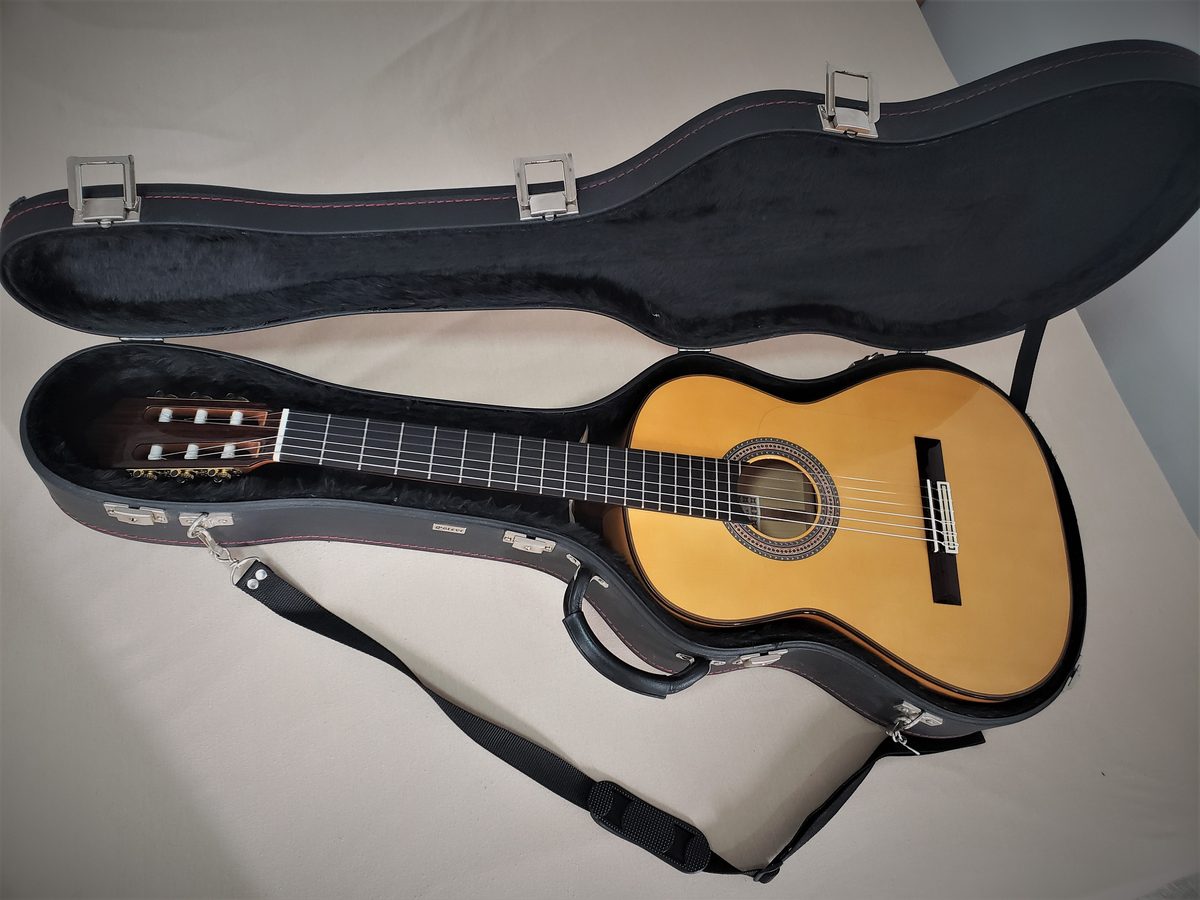
Five traditional palos, each with distinct compás and tonality. Flamenco technique draws on rasgueado, picado, alzapúa, and golpe.
Farruca
Traditional
Measured palo in 4/4, typically in A minor.
Soleá
Traditional
12‑beat compás with accents on beats 3, 6, 8, 10, and 12. One of the foundational palos of flamenco.
Bulerías
Traditional
12‑beat compás related to the soleá at higher tempo. Rapid rasgueado and syncopated figuration.
Taranta
Traditional
Free‑rhythm palo from the Levante mining tradition, typically in F‑sharp Phrygian. No fixed compás; tremolo and ornamental passages.
Malagueña
Traditional
Free‑rhythm form derived from the fandango, associated with Málaga. Typically in E Phrygian, with characteristic descending Phrygian cadence.
Notes
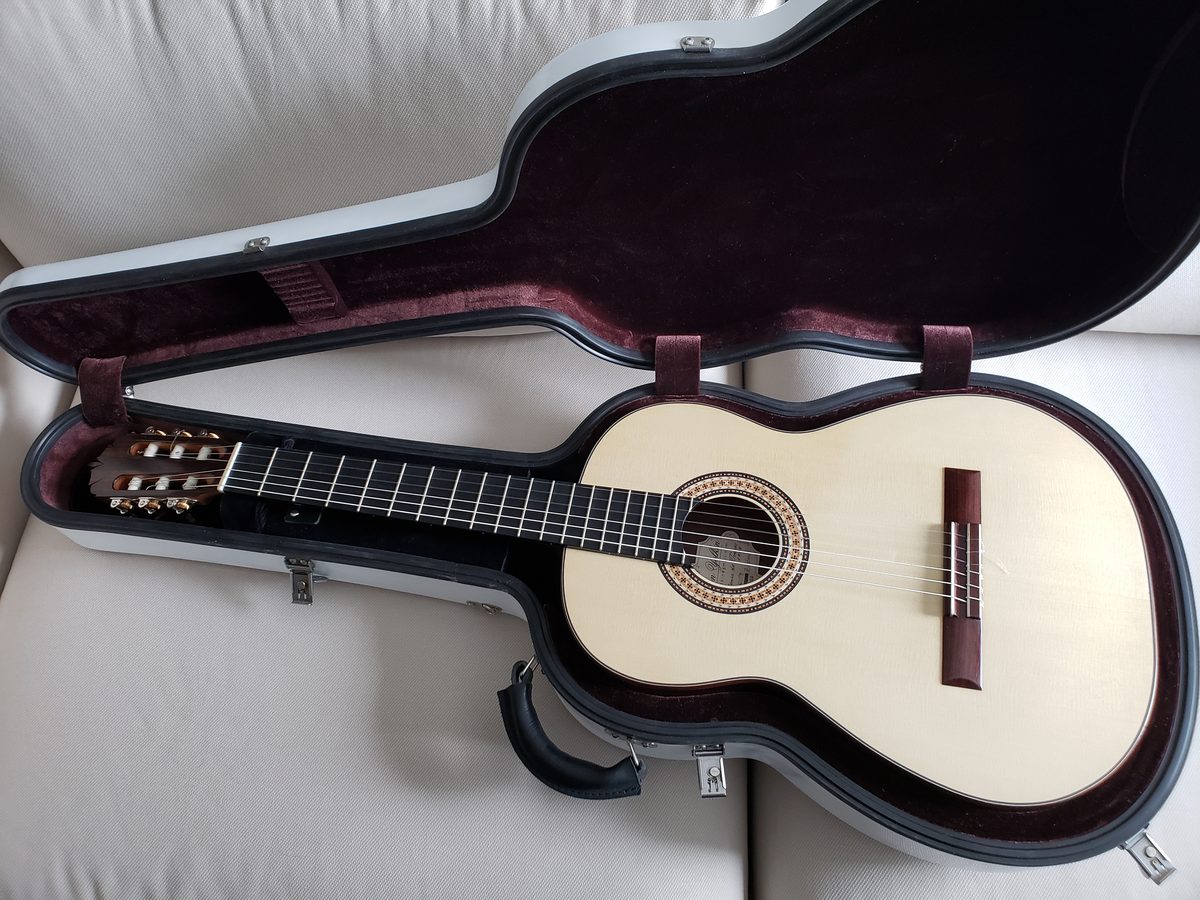
Concert performances are given on a guitar built by Russian luthier Simeon Yolkin, modelled after an 1888 instrument by Antonio de Torres.
Begin lessons
Schedule a lesson, or a complimentary fifteen‑minute consultation.